
Makena Gadient is a graduate of the Seattle Teacher Residency and works as an Extended Resource Teacher at Cleveland STEM High School in south Seattle.
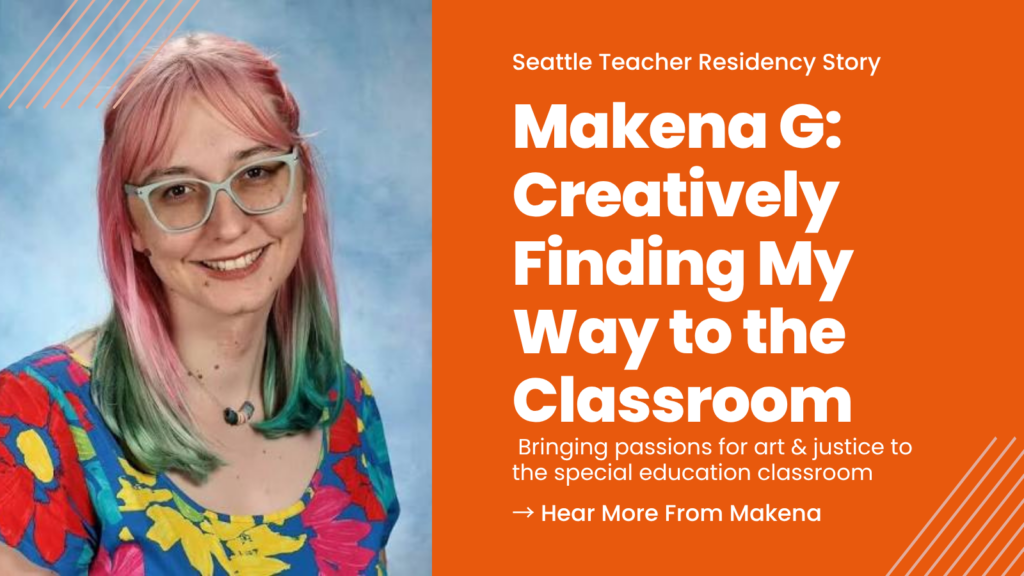
Becoming a teacher wasn’t something Makena planned right away. After graduating from Cornish College of the Arts, she was figuring out what came next and became a para educator at Seattle Public Schools in 2016. But a lot of what shaped her path started much earlier with her family.
“My younger sister has a disability. She has cerebral palsy. And so, the summer after I graduated, I was back home with her and training one of her at home aides.”
That experience made her realize how much knowledge she had already gained from supporting her sister and working with students with disabilities.
“I’ve been to lots of physical therapy appointments, speech therapy, occupational. I worked at a summer camp for kids with disabilities. I helped train the volunteers.”
At the time, becoming an instructional assistant felt like the right step. “That way, I’m still working with this population that I really care about and that I have a lot of experience in, but then I don’t have to go back to school to become a teacher, and I’m able to sit still, pursue visual arts.”
Makena worked as a paraeducator for several years. But during the pandemic, something shifted.
She was taking online classes through the Washington Education Association and realized she loved learning about education laws , practices and different ways to collect data.
That curiosity prompted her to start asking if it was time to go back to school or if she felt ready to shifted from being a para-educator to a classroom teacher. At the same time, her other passion of art had slowed down as the city shut down from COVID.
So: Makena took the leap and applied to the Seattle Teacher Residency (STR). But, the timing wasn’t exactly easy, she says, “I ended up actually getting vocal cancer, so I couldn’t talk. I did the interview and then I got in, and I was like, ‘how did I get in?’”
After deferring a year to recover, when she started the program, it confirmed that she made the right decision.
Why Seattle Teacher Residency
Makena had known about the STR program for years from colleagues.
“I remember my first year, actually, I worked in an elementary where there were a few Seattle Teacher Residency graduates that were there, and they were, like, almost immediately telling me I should do the program.”
What stood out to Makena was how prepared those colleagues were.
“They were the ones that were the most competent, both working with students with disabilities, as well as just, like, knowing about racial equity work and culturally diverse, like, linguistic classrooms.”
Seattle Teacher Residency is unique because it’s built through partnership. The Residency is a collaboration with four different entities: Seattle Education Association, Seattle Public Schools, University of Washington and Alliance for Education.
The residency model also means learning by doing.
“The really nice thing about a residency is that you’re in the classroom from day one. You’re doing mini lessons from day one. You’re doing one full day a quarter. Like right from day one. And then you’re really getting to observe your mentor teacher.”
For Makena, that real classroom experience made all the difference.
“I’ve worked with educators from other accelerated master’s programs who, in their first year as a classroom teacher, don’t have that competency and efficacy of knowing their strengths or weaknesses in the classroom because they’re still so new to working with students.”
Bringing Creativity Into the Classroom
Becoming a teacher, she could bring all parts of herself like her creative background into the classroom to help students engage with learning in ways that feel meaningful.
“I really think that my creativity got to show up in a new way. I got to design lessons, I got to design slides, I got to make up the projects.”
“Right now, we are designing a tote bag or a zipper bag. And the kids had to create a proposal and think through what could possibly go wrong and make a list of materials before they even did the project.”
Projects like this build multiple skills at once.
“We’re working on executive functioning skills, we’re working on our writing, we’re working on our project analysis and like all these different things.”
One of the practices she is most proud of is journaling. From the start of the year, students get their own journal and space to reflect privately.
“The kids get to pick them out. And then we do different prompts as well as different SEL (social-emotional learning) lessons where they have to reflect in their journal and they know that’s just for them and no one’s going to be reading it.”
Sometimes you see the impact of that practice in unexpected ways.
“I have a student who, this is her second year working with me and she was like, ‘yeah, it’s been really hard during junior year and a breakup and a lot of drama at home.’ Then she told me something that stuck with me. She’s like, ‘I’m almost done with the journal you gave me in October. Like, I’ve been journaling so much.’”
Breakthrough moments like that remind all teachers why they do this work and affirm that the skills that started long ago continue to make a difference for students.
Advice for Future Teachers
Teaching isn’t about fitting into a mold. It’s about bringing who you are into the classroom and knowing that students connect most when teachers bring their full selves to work.
“One of the things that really frustrated me when I wasn’t a classroom teacher was being bored in the class I was supporting. I just really encourage everyone to, if you’re thinking about being a teacher, to volunteer in a classroom to be able to know that who you are is really needed.”
Students need role models who show them different possibilities for their future. For Makena, that means bringing her interests and listening closely to theirs.
“Our students need examples of who they could be when they grow up. I don’t try to be a stereotypical teacher. I want to bring in being an artist and whatever my interests are and then try to really listen and hear what the kids are into.”
Last, but not least, if you’re considering the path to teaching, Makena’s biggest advice is simple: “Continue to ask for help and make your needs known.”
Once you’re in the classroom, that same mindset will help you advocate for your students, too.
Learn more about the Seattle Teacher Residency and make a gift to support future educators like Makena.